Neha, who leads after-sales at a battery manufacturer in Gujarat, approves a replacement for a battery that looks like an ordinary early failure. Two weeks later, she finds the same serial number in an older claim from a different dealer. Nothing in the paper file could have warned her, and that is how battery warranty fraud often passes unnoticed. It is also the point where digital warranty management starts to make a real difference, as the next sections show.
What Is Battery Warranty Fraud?
Battery warranty fraud happens when a claim is false or inflated to obtain a replacement or payment the manufacturer does not owe. It takes several forms. A battery may be claimed twice under the same serial number; a sale date may be moved to bring an expired battery back inside the warranty period, or damage caused by misuse may be presented as a manufacturing defect. Sometimes the serial number on the claim belongs to a battery that was never sold at all. Neha is an imaginary example, but anyone who handles claims will recognise these situations, and most of them stay invisible when claims are checked one at a time on paper.
Why Do Manufacturers Need Digital Warranty Management?
Because fraud rarely shows up in a single claim. Each one looks reasonable on its own, and the pattern appears only when claims are compared with each other and with sales records, which is hard to do in a file cabinet or a shared sheet. The true scale is also unknown. A 2019 Warranty Week article, drawing on a book by Kurvinen, Töyrylä and Murthy, noted estimates as high as 10% of warranty expenses, while admitting that many cases are never reported. Your own share may be far smaller, but it is a cost worth testing. Digital warranty management puts sales, claims and decisions into one record, so comparisons that once took days happen as each claim arrives, and good battery warranty management can be built on top of it.
How Does Digital Claim Verification Work?
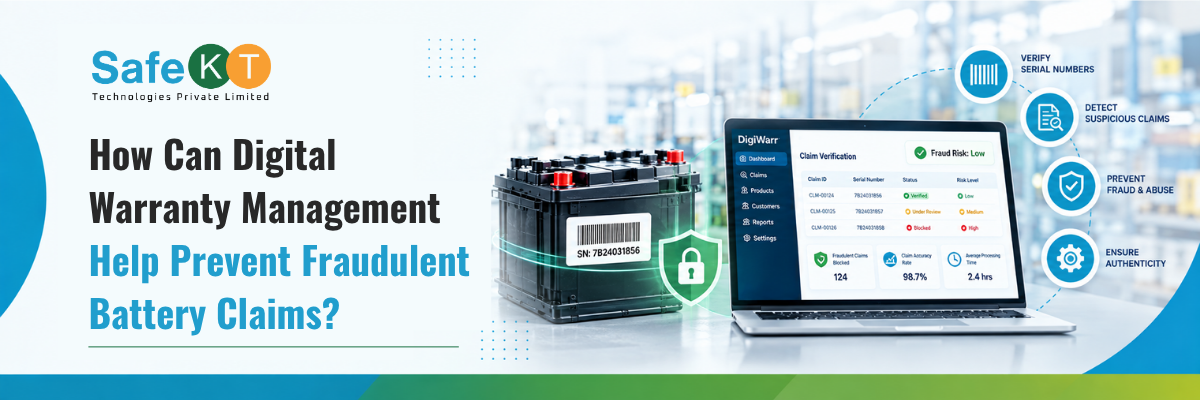
When a claim is raised, the system checks it against what it already knows before a person looks at it. Warranty claim verification of this kind usually asks a few questions in a fixed order:
- Does this serial number exist, and was the battery actually sold?
- Is the sale date inside the warranty period?
- Has this battery been claimed or replaced before?
- Was the claim raised by an authorised dealer?
Claims that pass move ahead quickly and claims that fail any check are held with a reason attached. This is the core of battery claim verification, and it helps honest dealers too, because genuine claims stop waiting in the same queue as doubtful ones.
Why Is Battery Serial Number Verification Important?
A serial number is a battery’s identity, so almost every fraud attempt touches it. Numbers can be copied from a genuine battery, entered with small changes, reused after a replacement or taken from stock that has not been sold. Checking the serial number against production and sales records catches these quickly, because the system knows when each battery was made, where it went, and whether a warranty has started. A paper register cannot do this reliably, since the person at the counter cannot see another dealer’s records. When a serial number fails the check, Neha’s team can ask for proof of purchase before any replacement leaves the warehouse, which is far cheaper than recovering one afterwards, and genuine battery warranty claims are settled faster as a result.
How Can Warranty Data Help Identify Suspicious Claims?
Data shows patterns that people miss. One dealer may raise claims at twice the rate of others selling similar volumes; many claims may arrive within days of a sale, or the same fault description may repeat across unrelated customers. None of this proves wrongdoing, and many cases have simple explanations such as a weak batch or a new dealer still learning the process. They are signals to look into, not accusations. A good system raises them early, so fraudulent warranty claims are examined while the evidence is fresh and honest dealers are not treated as suspects. Have you ever compared claim rates across dealers of similar size?
How Does Claim History Support Fraud Prevention?
Every battery and every dealer builds a history, and that history is the strongest tool for warranty fraud prevention. A battery with an earlier replacement, a rejected claim or a service note about physical damage deserves a closer look before a second claim is approved. The same applies to dealers whose past claims were often rejected. When decisions and reasons are recorded, different people treat similar claims in the same way, which also makes a rejection easier to explain to a dealer calmly and with facts. Over time, the record can deter misuse as well, because people who know every claim is compared with history are more likely to think twice.
Why Should Manufacturers Digitise Warranty Records?
Paper cards, dealer notebooks and photographs sent over messaging apps work until a question crosses departments. Finding who sold a battery, when, and what happened afterwards means contacting several people, and by then the details are blurred. Digital records are searchable, timestamped, and shared, so the sales, service, and finance teams see the same facts. A digital warranty system also keeps a trail of who approved what and when, which matters if a dispute reaches a dealer’s owner or a customer’s lawyer. It does not need to be complicated at the start. Recording the sale date and serial number at the counter already fixes the most common weakness.
How Can Digital Warranty Software Reduce Fraudulent Claims?
Battery warranty software reduces fraud mainly by making checks automatic and records shared. Serial numbers are validated, sale dates are confirmed, repeated claims are flagged, and unusual dealer patterns appear on a screen instead of being discovered by chance. That leaves the team free to focus on claims that deserve attention while genuine ones move faster. Software can flag a claim, but people still decide, so clear battery warranty management policies remain important, and honest customers should never be penalised for a dealer’s mistake.
Strong digital warranty management depends on rules and workflows as much as on the tool. Before choosing anything, a business should decide what counts as a suspicious claim, who reviews it and how quickly.
If your claims team still relies on memory and paper to catch problems, SafeKT can help you review your current claim process, find where battery warranty fraud could slip through, and put a practical approach to warranty fraud prevention in place that suits your dealers and customers. Then Neha’s next duplicate serial number is stopped at the first claim instead of being found after the second.
FAQs
How can digital warranty management prevent fraud?
Digital warranty management records every sale and claim in one place and checks each new claim against that history. Duplicate serial numbers, expired warranties, unsold batteries and unusual dealer patterns are flagged automatically, so suspicious claims are reviewed before a replacement is issued.
How are battery warranty claims verified?
The claim is matched with production and sales records. The system confirms the serial number is valid and sold, the warranty is still active, the dealer is authorised, and no earlier claim exists. Claims that fail a check are held for review with the reason shown.
Why is serial number verification important?
The serial number is the battery’s identity. Verifying it against production and sales records exposes copied, reused and unsold numbers, confirms the real sale date and prevents the same battery from being replaced twice. Without it, manufacturers rely on whatever the claim form says.
How can manufacturers identify fraudulent warranty claims?
Spotting fraudulent warranty claims starts with comparing claims against sales records and against each other. Warning signs include repeated serial numbers, claims soon after sale, one dealer with unusually high claim rates and identical fault notes. These are prompts for a closer look, not proof.
What are the benefits of a digital warranty system?
A digital warranty system gives faster claim decisions, fewer duplicate or invalid replacements, a clear record of approvals and better data on which models and dealers cost the most. Genuine customers gain too, since their claims are verified quickly instead of waiting in a pile.